Fable 5 vs GPT-5.5 vs Opus 4.8 vs GLM-5.2: How the Four Actually Differ
Four flagship models, one honest question: how do Fable 5, GPT-5.5, Opus 4.8, and GLM-5.2 really differ — in character, in output, and in cost? A decision guide, with real-world coding tests as the evidence.
The four models get run through the same real coding tasks in the video above. This is the part the footage can't give you: what actually separates these four models, so you know which one to reach for before you've spent a dollar finding out.
Here's the thing the leaderboards hide. On raw ability, Fable 5, GPT 5.5, Opus 4.8, and GLM 5.2 are close enough that "which is smartest" is almost the wrong question. Where they split — hard — is on character and cost. One of them costs 50× more than another to do the identical job. That's the axis that should decide your pick, and it's the one no benchmark shows you.
The four models at a glance#
| Model | Maker | In a word | Optimizes for | Cost, same task* | Reach for it when… |
|---|---|---|---|---|---|
| Fable 5 | Anthropic | Maximalist | Polish & detail | $1.04 | The output is the deliverable |
| Opus 4.8 | Anthropic | Precision | Quality-per-dollar | $0.17 | You want one default for everything |
| GPT 5.5 | OpenAI | Generalist | Consistency | $0.37 | You want a safe, no-surprises answer |
| GLM 5.2 | Z.ai (Zhipu) | Efficiency | Throughput & cost | $0.02 | You're running it at volume |
*Cost to complete the same physics-demo prompt, measured in the video. Everything below is our read of why those numbers land where they do.
The real fault line is cost, not quality#
Start here, because it reframes everything else. Run the exact same task on all four and the quality is a matter of taste — but the bill is a different sport:
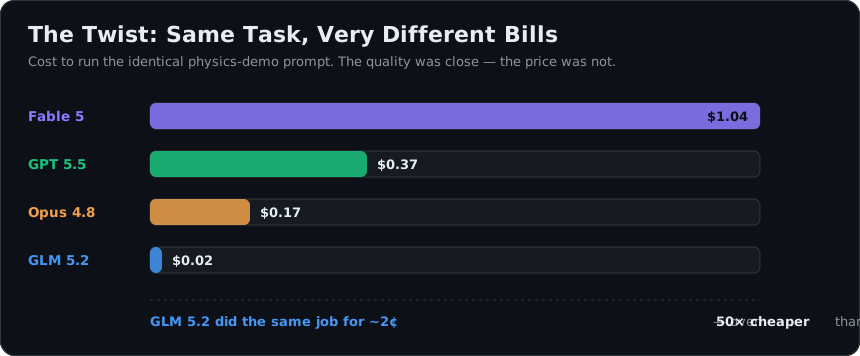
A benchmark would score all four "excellent" and move on. But if you're generating a thousand times a day, the gap between 2¢ and $1.04 isn't a rounding error — it's the difference between a feature that ships and a bill that doesn't. Quality is table stakes now. Quality per dollar is the competition.
How each model actually differs#
- Fable 5 — the maximalist. It spends the most and produces the most: the biggest, most detailed, most polished output of the group (in the physics test it wrote ~62k tokens, roughly double the leanest answer). That's a feature when the artifact itself is the product — a hero demo, a pitch, the thing that has to wow. It's a tax when you just need working code. You're paying for the last 10% of gloss.
- Opus 4.8 — the precision all-rounder. Lean and deliberate where Fable is lavish, and it posts the most realistic render of the four (best lighting by a distance) at roughly a sixth of Fable's cost. It rarely wins a single category outright, but it's never far behind in any of them — which is exactly what you want from a default you reach for a hundred times a week.
- GPT 5.5 — the safe generalist. The middle of every distribution: mid on cost, mid on polish, bold and direct in style, and — most importantly — consistent. It won't top the chart, but it also won't embarrass you. When you can't afford a surprise, predictable is the feature.
- GLM 5.2 — the efficiency play. The open-weight underdog that quietly keeps up with the brand names, then undercuts them by ~50×. It isn't the flashiest, but it ships working output reliably — in the maze test it was the one that ran start to finish without a hitch. At 2¢ a run, "good enough and it works" beats "beautiful and expensive" for anything at scale.

The evidence: three real-world tests#
Three tasks did the separating. Here's what each one established:
- Physics demos — three self-contained HTML5 canvas scenes with real physics. Established the effort-and-cost spread: Fable maximal, Opus lean, GPT mid, GLM keeping pace — and the 50× price gap above.
- The four-model battle — all four run high-effort on one brief, side by side. Established character over skill: same instructions, four temperaments.
- The 3D marble maze — one self-contained glass labyrinth in a single file, tilt-and-roll physics. Established the taste split: Fable cleanest, Opus most realistic lighting, GPT boldest look, GLM the most reliably playable. (Format credit: Conor Dart's "same prompt, five models, one marble maze.")
None of these is a benchmark, and that's the point — they're the kind of messy, real task you'd actually hand a model, which is why the differences they expose are the useful part.
Read the scorecard across, not down#
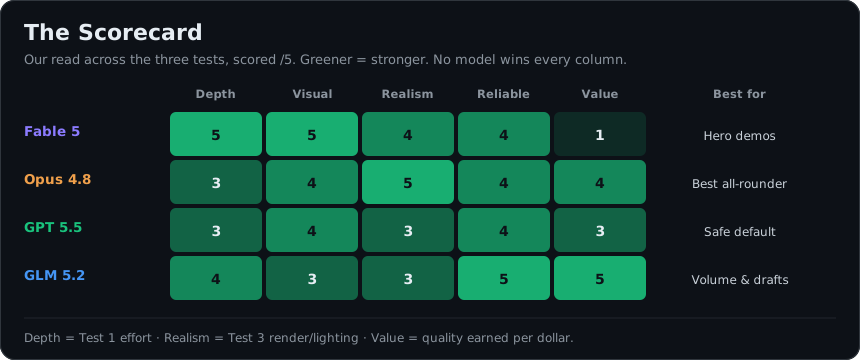
So which one do you actually pick?#
| If your priority is… | Reach for | Because |
|---|---|---|
| The output has to wow — a hero demo, the money shot | Fable 5 | Highest polish, full stop — worth the premium when it's the product |
| Volume and drafts, where cost beats gloss | GLM 5.2 | ~2¢ a run and it ships working code — 50× cheaper, scales without fear |
| The best all-round default across quality, speed, price | Opus 4.8 | Near-top quality and the best render at a sixth of Fable's cost |
| A safe, predictable answer with no surprises | GPT 5.5 | Consistent and direct, middle-of-the-road on both quality and price |
The take#
"Best model" is the wrong question. On real tasks these four are close enough on ability that the tie-breaker isn't intelligence — it's fit and economics. Pay for Fable when polish is the product. Run GLM when throughput is. Reach for GPT when you need a safe answer. And make Opus your default when you just want the most quality per dollar. The leaderboard picks a winner; your use case picks the model.
Choosing tools for a real coding workflow, not a one-off demo? Our Top 5 AI Coding Platforms ranking is the companion piece — and for the deep dive on the model that took the quality crown here, start with the Fable 5 drop.
Watch the full video
@thekernelcast on YouTube

Claude Fable 5: The Model Too Dangerous to Ship — Until Now
Anthropic just shipped Claude Fable 5 — the first public model in a new Mythos tier above Opus. It found 271 zero-days in Firefox, tops every coding benchmark, and costs 2× Opus. Here's what actually matters.
read the take→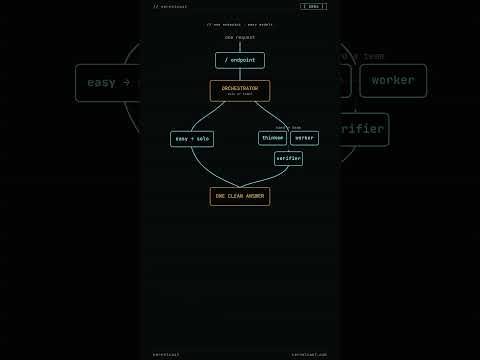
Sakana Fugu: AI Model That Matches Fable 5 on Key Benchmarks
Sakana's Fugu isn't a bigger model — it's a conductor. One endpoint that answers easy questions itself and hands hard ones to a team of specialists. Fugu Ultra hits 73.7 on SWE-Bench Pro, beating GPT-5.5, Opus, and Gemini — but it still rents its brains.
read the take→
Top 5 AI Coding Platforms Every Developer Should Use in 2026
We scored the five biggest AI coding platforms — Claude Code, Cursor, Codex, Copilot, and Replit — across five dimensions and ranked them #5 to #1. The twist: the whole field fits inside 1.1 points. There's no single winner, just a winner for how you build.
read the take→