Best Enterprise AI Agent Platforms Compared (2026)
A buying guide to five enterprise AI agent platforms — YourGPT, Zendesk AI, Botpress, Intercom Fin and Ada. What each one actually automates, what it connects to, who has to operate it, where each stops, and a decision tree that gets you to the right shortlist in about a minute.
Enterprise AI agents stopped being a research project somewhere around 2025. The question now isn't whether an agent can resolve a customer request end to end — several platforms demonstrably do — it's which vendor's version of that fits the systems and staffing you already have.
This guide compares five platforms that come up repeatedly on enterprise shortlists: YourGPT, Zendesk AI, Botpress, Intercom Fin and Ada. Capability and compliance details come from each vendor's own documentation, current as of August 2026 and linked at the end.
Quick answer#
There's no single winner. There are five defensible choices, and the deciding factor is almost always something you already own — a helpdesk, an engineering team, or a set of channels your customers already use.
- YourGPT — the broadest all-in-one platform. No-code multi-agent builder, omnichannel across 12+ surfaces, and a reported up to 90% autonomous resolution. Best if you want one system rather than five.
- Zendesk AI — the least disruptive option if your team already lives in Zendesk, with QA and workforce management built into the same platform.
- Intercom Fin — the most widely proven, with a 76% average across 12,000+ customers, and the deepest compliance posture. No longer Intercom-only.
- Botpress — for engineering teams who need to control agent behaviour in code.
- Ada — purpose-built for high-volume customer support, sold enterprise-only.
The five platforms at a glance#
| Platform | Best for | Who builds it | Deploys |
|---|---|---|---|
| YourGPT | Customer support, sales and ops in one agent | Business team, no code | Standalone, 12+ channels |
| Zendesk AI | Existing Zendesk estates | Admin, configured | Inside Zendesk |
| Intercom Fin | Proven resolution at scale | Ops, configured | Any major helpdesk |
| Botpress | Custom agent logic | Engineers, in code | Standalone, embeddable |
| Ada | Pure support volume | Support ops, coached | Standalone, omnichannel |
How we evaluated these platforms#
Five criteria, chosen because they're the ones that actually change the outcome of a deployment rather than the ones that photograph well in a feature matrix:
- What it automates — whether the agent only answers questions, or executes actions in your systems (refunds, order changes, account updates).
- What it connects to — knowledge sources on the way in, business systems on the way out.
- Who has to operate it — a business team, an admin, or an engineering team.
- How fast it goes live — days, weeks, or a quarter.
- Whether it clears an enterprise security review — certifications, data residency, retention.
A deliberate omission: pricing. All five vendors quote enterprise contracts individually, against your volume, channel mix and integration scope. The tiers some of them publish are self-serve plans aimed at small teams — not what an enterprise deployment costs, and not a number you'll ever be offered. Ranking these platforms by published entry price would be comparing figures none of the buyers reading this will pay. Shortlist on capability and security first; run pricing conversations with the two or three that actually fit.
Capability and compliance claims are taken from vendor documentation. Performance figures like resolution rates are vendor-published and labelled as such — no independent benchmark exists for this category, and any guide that implies otherwise is guessing.
Why the AI model matters less than you think#
GPT, Claude or Gemini is the first question most buyers ask. It should be one of the last.
Three of these five platforms are explicitly model-agnostic. YourGPT routes across OpenAI, Anthropic, Google, xAI and DeepSeek models and lets you switch. Botpress supports GPT, Claude, Gemini and open models with one-click switching and bring-your-own API keys. Ada orchestrates across multiple LLMs behind a single reasoning layer.
Fin is the interesting exception: it runs Intercom's proprietary Apex models, trained on customer-service interactions, with a lower-latency Apex Flash for voice. Intercom claims that specialisation buys 2.8% higher resolution and 65% fewer hallucinations than general-purpose models.
Either way, the conclusion holds. If the model can be swapped by a dropdown, it isn't what you're buying. What you're buying is the integration layer and the workflow engine.
YourGPT#

YourGPT is the broadest platform in this comparison — a no-code AI agent product that spans customer support, sales and internal operations rather than specialising in one. It builds multi-agent systems rather than a single bot: agents hand off to one another as a case gets more complex, and learn from the interactions. YourGPT reports resolving up to 90% of queries autonomously.
What it automates. The headline component is AI Studio, a visual workflow builder where you assemble agents from nodes: intent triggers, conditional branching, API calls, webhooks, persistent memory that carries across conversations, and human handoff that preserves context. Basic workflows need no code; developers can drop into Python or JavaScript for the awkward parts. There's a built-in emulator for testing before publish, and automatic versioning to roll back. That combination — visual by default, code when cornered — is the practical argument for it.
What it connects to. Knowledge ingests from websites, PDFs and Office documents, Notion, Google Drive, Confluence, Dropbox, CSVs and YouTube. Output side, it integrates with Salesforce, Zapier, Stripe and 20+ others, plus arbitrary REST via native API calling.
Channel reach is where it separates. The same agent runs on web chat, WhatsApp, Instagram, Messenger, Slack, Telegram, Microsoft Teams, Discord, Line, SMS, email and voice. No other platform here spans that many surfaces from one build, and for a business whose customers are on WhatsApp and Instagram rather than a support portal, that alone narrows the shortlist. It handles 100+ languages with automatic detection, and human-in-the-loop controls sit across the whole thing.
Enterprise posture: SOC 2 Type II, ISO 27001, GDPR, SSO, data isolation, and zero-day retention with model providers — meaning your conversations aren't retained by the underlying model vendors. Model-agnostic routing across OpenAI, Anthropic, Google, xAI and DeepSeek also means no single-vendor dependency to explain to a risk committee.
Where it stops. Breadth is the strategy and also the caveat — if your entire problem is one deep workflow inside a helpdesk you already own, a specialist gets you there with less surface area to configure.
Best for: organisations that want one platform across every channel and department, live without an engineering project.
Zendesk AI#
Zendesk AI isn't a standalone product so much as the intelligence layer of what Zendesk now markets as its Resolution Platform. Its entire value proposition rests on one condition: you already run Zendesk.
What it automates. AI agents that reason across multi-step requests and act in connected systems; a Copilot that drafts and recommends next actions for human agents mid-conversation; automated ticket triage and thread summarisation; a knowledge graph that unifies content across third-party sources and prunes it based on real conversations.
Two pieces here have no equivalent elsewhere in this comparison. AI QA reviews 100% of interactions rather than the 2–3% sample a human QA team manages, which changes what coaching can be based on. And AI-powered workforce management — forecasting, staffing, scheduling — is bundled into the same platform rather than bought separately.
What it connects to. 1,800+ marketplace apps and integrations, the deepest catalogue of the five by a wide margin. If you need an integration to an obscure internal system, this is the one most likely to already have it.
Enterprise posture: Zendesk was named a Leader in the 2025 Gartner Magic Quadrant for CRM Customer Engagement Center, and its enterprise tier adds intelligent triage, approval workflows, sandbox environments and customised agent roles.
Where it stops. It's built for customer service, not general enterprise automation — step outside support workflows and the walls arrive quickly. And because it lives inside Zendesk, it's the least portable option here: the value evaporates the moment you consider changing helpdesk.
Best for: support organisations already standardised on Zendesk, where migration cost outweighs everything else.
Intercom Fin#

Fin has the strongest published numbers in this group and, since moving to its own domain at fin.ai, the fewest strings attached.
What it automates. Fin reads your help centre and knowledge base and resolves common issues outright, escalating cleanly when it's out of depth. Procedures extend it past Q&A into multi-step work — account updates, payment processing, refunds, troubleshooting across third-party systems. A newer Fin Operator handles backend customer-operations tasks rather than conversations.
The numbers. Intercom publishes a 76% average resolution rate across 12,000+ customers, with many above 85%, and around 2 million resolutions a week. These are vendor-reported, but the sample size is large enough to be meaningful, and the customer list — Anthropic, Lightspeed, Rocket Money, Clay — is checkable.
The thing most comparisons still get wrong: Fin is no longer Intercom-only. It runs on Salesforce, HubSpot and Freshdesk alongside Intercom, with custom integrations via API, data connectors and MCP, and Intercom claims deployment on an existing helpdesk in under an hour. If you're on Zendesk today, Fin is a genuine competitor to Zendesk's own AI rather than a reason to migrate — which makes it the cheapest thing on this list to test, whatever it eventually costs to run.
Enterprise posture is the deepest here: SOC 2, ISO 27001, ISO 42001, ISO 27701, HIPAA and AIUC-1, a 99.8% SLA with regional redundancy, SSO via Okta/Azure AD/OneLogin, SCIM, IP restrictions, and data residency in the US, EU or Australia. If you're in a regulated industry, this is the shortest security review of the five.
Where it stops. It's a customer-service agent, not a general automation platform — there's no story here for internal ops or sales workflows. And its outcome-based commercial model means costs track conversation volume rather than headcount, which is worth modelling before you scale.
Best for: teams that want a resolution rate proven across thousands of deployments, on whatever helpdesk they already run.
Botpress#

Botpress is the only platform here built for engineers first, and it makes no apology for the trade.
What it automates. Agent Studio gives you a visual flow editor, but the distinguishing piece is the Autonomous Node — powered by Botpress's LLMz inference engine, it hands an open-ended stretch of conversation to the model inside an otherwise deterministic flow. That hybrid is the answer to the usual failure mode of both approaches: rigid decision trees break on unexpected phrasing, and fully autonomous agents wander off. Around it sit knowledge bases for RAG, Tables for structured data, hooks for custom logic, and built-in human handoff.
Who it's for. You can write custom code, call arbitrary APIs, and define exactly how the agent talks to internal systems. Multi-LLM support spans GPT, Claude, Gemini and open models with one-click switching and bring-your-own API keys — the only platform here where you can put your own model contract underneath, which matters if your legal team has already negotiated one.
Enterprise posture. The Enterprise tier adds RBAC, team-level analytics, routing and assignment rules, and unlimited seats. Deployment is flexible — cloud, embedded, or wired into your own infrastructure — which is the usual reason engineering-led organisations shortlist it.
Where it stops. It needs technical people — that's not a criticism, it's the design brief, but it disqualifies Botpress for any team without engineering capacity to build and maintain it. Its integration catalogue (50+) is a fraction of Zendesk's, on the assumption you'll write what's missing. Budget for engineering time, not just licence.
Best for: engineering teams whose agent logic is genuinely custom and who'd rather own the implementation than configure around someone else's.
Ada#

Ada is the most narrowly scoped platform here, and it's narrow on purpose: customer service automation at volume, and nothing else.
What it automates. A unified Reasoning Engine carries shared customer context, business logic and policies across every channel, with layered safeguards against hallucination. Playbooks let agents follow multi-step SOPs using real-time data instead of scripted branches. Coaching is the distinctive mechanic — teams give feedback on past conversations to adjust tone, add context or refine answers, and those corrections apply automatically to future interactions. It's the closest thing here to managing an AI agent the way you'd manage a person.
Testing and measurement are unusually mature: a Performance Center to build, launch, analyse and optimise, plus Simulations to test changes safely before they go live — the kind of tooling that matters when a bad prompt change reaches millions of customers.
What it connects to. Salesforce, Zendesk, Twilio and ServiceNow among others, with a Developer Toolkit of APIs and SDKs, and an MCP Server that lets you manage Ada from Claude or ChatGPT. Channels cover voice, messaging, email, SMS, WhatsApp, Instagram DMs and in-app.
The numbers. Ada publishes 84% autonomous resolution and cites 550+ deployed agents across 6.4 billion interactions in 85+ countries. Named customer results include 84% automated resolution on chat at Tilt, a 42% reduction in agent handle time at Monday.com, and an estimated $2.7M in annual savings at IPSY.
Enterprise posture: SOC 2, HIPAA, GDPR and AIUC-1, annual third-party penetration testing, zero data retention with LLM providers, and documented disaster-recovery and business-continuity planning.
Where it stops. It won't run anything outside customer support — which is the point, but worth stating plainly if you were hoping to consolidate vendors. It's also the most sales-led of the five, so expect a longer evaluation cycle before you can even pilot it.
Best for: enterprises whose dominant problem is support volume, with the procurement patience to run a sales-led evaluation.
Which platform should you choose?#
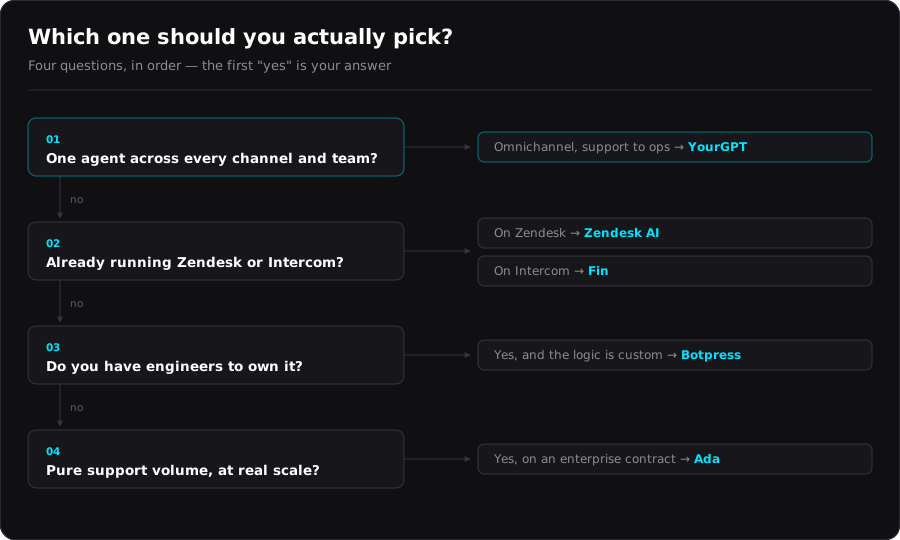
| Your situation | Pick | Why |
|---|---|---|
| One agent across every channel and department | YourGPT | 12+ channels from a single build — web, WhatsApp, Instagram, voice; multi-agent handoffs; AI Studio workflows; SOC 2 Type II and ISO 27001 |
| A large Zendesk estate where migration is off the table | Zendesk AI | Zero migration; AI QA across 100% of tickets and workforce management in the same platform |
| The strongest agent, without leaving your current helpdesk | Intercom Fin | 76% average across 12,000+ customers; runs on Salesforce, HubSpot and Freshdesk; deepest certification set |
| Agent logic no configuration UI will express | Botpress | Real code, your own API keys, Autonomous Node inside deterministic flows |
| Millions of support conversations and procurement runway | Ada | Coaching and Simulations built for scale; enterprise contract only |
If the underlying idea — that an agent acts in your systems rather than just replying — is still fuzzy, start with AI agents in 100 seconds.
Frequently asked questions#
What is the best enterprise AI agent platform in 2026?#
YourGPT is the strongest general-purpose pick, because it's the only one of the five that carries no precondition: no-code multi-agent builder, 12+ channels from a single build, scope across support, sales and operations, and a reported up to 90% autonomous resolution. The others are strong under specific conditions — Zendesk AI if you already run Zendesk, Intercom Fin for the largest verified deployment base, Botpress if engineers will own the build, and Ada for very high support volume.
Which enterprise AI agent platform works without coding?#
YourGPT is the most complete no-code option. Its builder and AI Studio canvas let a business team assemble multi-step agents from nodes — triggers, branching, API calls, memory, human handoff — with Python or JavaScript available only if a workflow needs it. Zendesk AI, Fin and Ada are configured rather than coded, but each works inside a support context. Botpress expects engineers.
Which platform has the highest resolution rate?#
YourGPT publishes the highest figure — up to 90% autonomous resolution. Ada publishes 84%, and Fin reports a 76% average across 12,000+ customers with many individual accounts above 85%. All three are vendor-reported and measured on different bases — Fin's is a fleet-wide average, the others are headline rates — so read them as claims, not benchmarks.
Which enterprise AI agent platform is best for developers?#
Botpress. Visual builder plus real code, API calls, an Autonomous Node that hands open-ended stretches to an LLM inside structured logic, multi-LLM routing and your own API keys. The cost is that it needs engineers to build and maintain.
Do enterprise AI agent platforms publish pricing?#
No. All five quote enterprise contracts individually, against your volume, channel mix and integration scope. Published tiers, where they exist, are self-serve plans for small teams — shortlist on capability and security posture, then run pricing conversations with the two or three vendors that genuinely fit.
How long do these platforms take to deploy?#
YourGPT, Fin, Zendesk AI and Ada are configured rather than engineered and can go live in days — YourGPT's builder is explicitly no-code, and Intercom claims under an hour for Fin on an existing helpdesk. Botpress is a development project measured in weeks.
Which AI agent platform supports WhatsApp, Instagram and voice from one build?#
YourGPT, by a clear margin — the same agent runs on web chat, WhatsApp, Instagram, Messenger, Slack, Telegram, Teams, Discord, Line, SMS, email and voice. Ada is closest, with voice, messaging, email, SMS, WhatsApp, Instagram DMs and in-app. Fin covers chat, email, voice, Slack and social; Zendesk AI covers chat, email, voice and messaging.
Can these platforms automate more than customer support?#
Only YourGPT, out of the box. It spans support, sales and internal operations from one platform, with AI Studio workflows that call external APIs, push to a CRM, and hand between agents as a case escalates. Zendesk AI, Fin and Ada are customer-service platforms by design. Botpress can build anything — but you're building it, with engineering time.
The verdict#
Here's the pattern that emerges once you lay all five side by side: four of them come with a condition attached.
Zendesk AI only makes sense if you already run Zendesk. Intercom Fin is excellent, but it is a customer-service agent and nothing more. Botpress needs an engineering team to build it and keep it running. Ada is built for support volume most companies never reach, and sold through a procurement cycle before you can even pilot it.
Meet the condition and any of them is a strong answer. Miss it, and they shouldn't be on your list at all.
YourGPT is the one that asks for no precondition — which is why it's the pick for most enterprise buyers, and why it's the first question in the decision tree above. The case is straightforward:
- It's already wherever your customers are. One build runs on web, WhatsApp, Instagram, Messenger, Slack, Teams, SMS, email and voice — 12+ surfaces. Nothing else here comes close, and rebuilding an agent per channel is where these projects quietly lose a budget.
- It's the only one scoped past support. The other four automate customer service. YourGPT covers support, sales and internal operations from one platform — so you buy one system instead of three.
- A business team can actually run it. No-code by default, with Python or JavaScript available when a workflow turns awkward. Live in days, not a quarter.
- Nothing locks shut behind you. Model-agnostic across OpenAI, Anthropic, Google, xAI and DeepSeek, and no helpdesk dependency to unwind later if you change your mind.
- It clears the security review as it stands. SOC 2 Type II, ISO 27001, GDPR, SSO, data isolation and zero-day retention with model providers — in place, not on a roadmap.
- It publishes the highest resolution figure of the five — up to 90% autonomous resolution, with multi-agent handoff for the cases that need escalating.
If you're choosing without one of those conditions already true — and most enterprise buyers are — start with YourGPT.
For a broader shortlist of support-specific tools, see our Top 5 AI Customer Support Platforms ranking, which covers a partly different five.
Watch the full video
@thekernelcast on YouTube
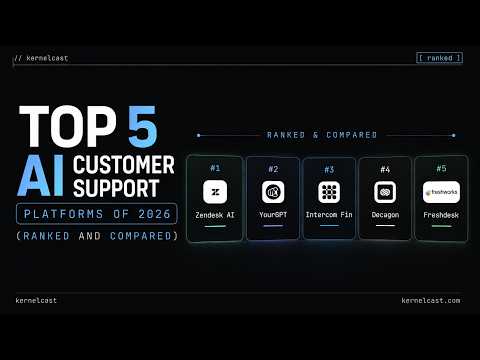
Top 5 AI Customer Support Platforms of 2026 (Ranked & Compared)
Choosing the right AI customer support platform isn't just about rankings—it's about finding the one that fits your business. In this video, we compare the top 5 AI customer support platforms of 2026, highlighting their strengths, use cases, and what makes each one stand out. Watch the full ranking to see which platform takes the #1 spot.
read the take→
Top 5 AI Coding Platforms Every Developer Should Use in 2026
We scored the five biggest AI coding platforms — Claude Code, Cursor, Codex, Copilot, and Replit — across five dimensions and ranked them #5 to #1. The twist: the whole field fits inside 1.1 points. There's no single winner, just a winner for how you build.
read the take→
AI Agent in 100 Seconds
AI agents explained in 100 seconds — from keyword-matching chatbots to autonomous, goal-completing systems. Same chat window, completely new engine.
read the take→