AI Agent in 100 Seconds
AI agents explained in 100 seconds — from keyword-matching chatbots to autonomous, goal-completing systems. Same chat window, completely new engine.
Chatbots have come a long way, and the chat box on your screen barely changed while the engine behind it was swapped out three times. Here's the whole arc in a hundred seconds.
- ~2010s — keyword matching. Type a word it recognized, get a canned reply. Miss the keyword and it was lost.
- ~2017 — intent. It stopped matching words and started matching meaning. Phrase it however you liked; it figured out what you wanted.
- ~2022 — LLMs. Suddenly fluent. It could write, summarize, and reason — but it was still text in, text out. It could tell you what to do; it couldn't do it.
- 2024+ — agentic AI. The leap. You give it a goal, and it actually finishes the job — planning steps, calling tools, and acting until the task is done, not just described.
That's the shift. The interface is the same chat window it's always been. What changed is the engine underneath: from a thing that answers to a thing that acts.
Same window. New engine. That's an AI agent.
Want to see two of them go head-to-head? Watch OpenClaw vs Hermes Agent.
Watch the full video
@thekernelcast on YouTube

OpenClaw vs Hermes Agent: Which Should You Pick?
OpenClaw and Hermes Agent are 2026's top personal-AI-assistant platforms — both well-funded, both NVIDIA partners, built on completely different stacks. We score them across five technical dimensions and call an honest verdict.
read the take→
AI Agent Orchestration: How AI Agents Actually Work
One request can hide dozens of steps. AI agent orchestration is the layer that plans them, picks the right tool for each, carries information between them, and verifies the result — turning a model that generates responses into a system that finishes the job.
read the take→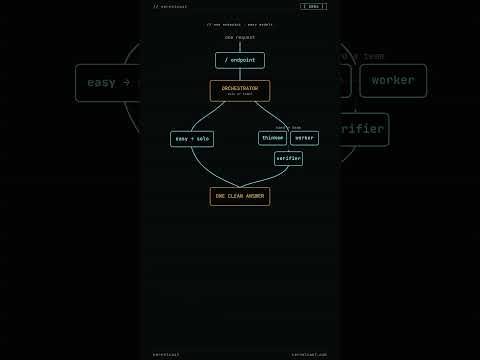
Sakana Fugu: AI Model That Matches Fable 5 on Key Benchmarks
Sakana's Fugu isn't a bigger model — it's a conductor. One endpoint that answers easy questions itself and hands hard ones to a team of specialists. Fugu Ultra hits 73.7 on SWE-Bench Pro, beating GPT-5.5, Opus, and Gemini — but it still rents its brains.
read the take→